
The Forest Is The Farm
How Syntropic Agriculture Creates Value Without Deforestation
Across the Amazon, agricultural development is often associated with clearing land and replacing diverse ecosystems with monocultures.
Syntropic agriculture follows a different path.
Rather than simplifying nature, it seeks to work with natural ecological processes, creating productive systems that resemble the structure and function of a healthy forest.
At Amazterra, we believe this approach offers a powerful opportunity for the future of rural development in Amazonas.
A Productive Forest
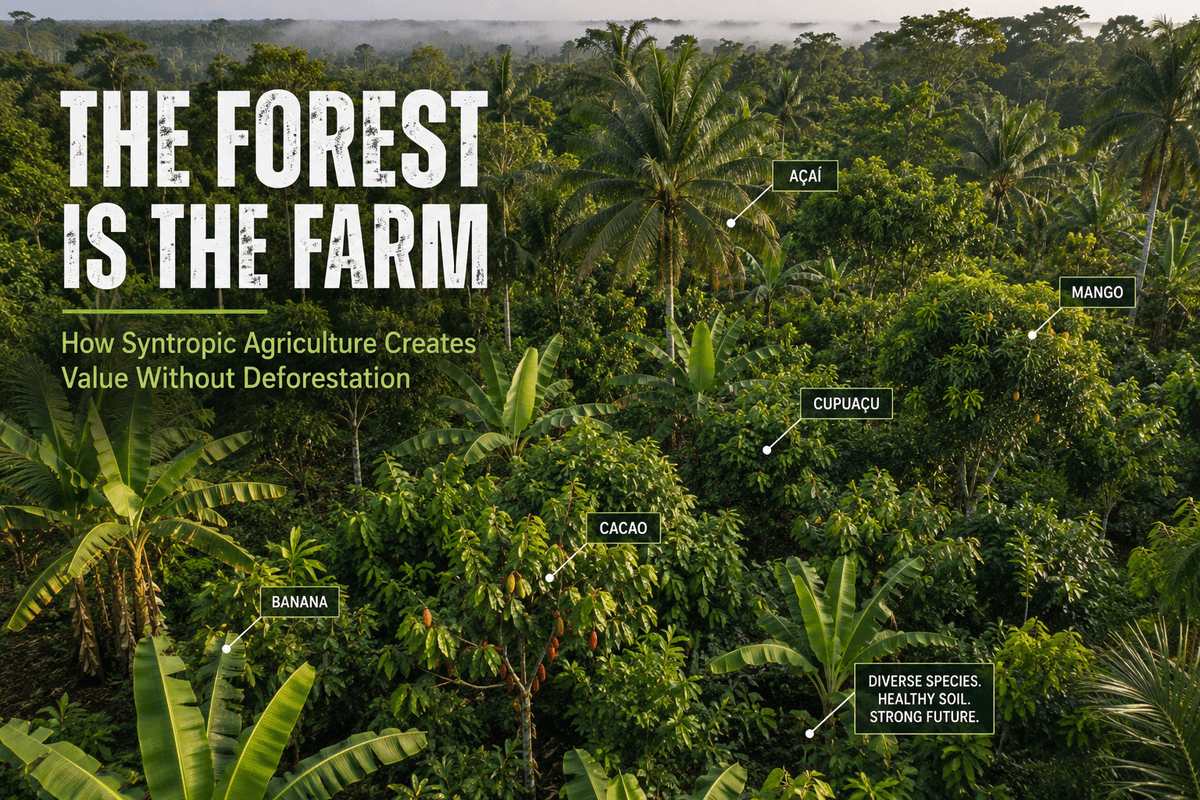
In a syntropic farming system, multiple crops grow together in different layers and stages of development.
Instead of planting a single crop across large areas, farmers combine species that support one another.
Together these plants create a living production system that continuously generates organic matter, protects the soil and improves biodiversity.
More Than Fruit Production
Syntropic systems are designed to create multiple sources of income.
While bananas may provide early returns, cacao and cupuaçu develop over the medium term, and açaí can generate productive harvests for many years.
The result is a more resilient farm economy that is less dependent on a single commodity or harvest season.
Building Soil Instead of Depleting It
One of the central principles of syntropic farming is the continuous generation of biomass.
Pruning residues are not considered waste.
They are returned to the soil where they:
- Increase organic matter
- Improve water retention
- Support soil biology
- Reduce erosion
- Improve long-term productivity
Over time, the system becomes increasingly fertile while requiring fewer external inputs.
Reducing Pressure on Forests
When degraded land becomes economically productive again, farmers face less pressure to expand into natural forest areas.
This creates an important alignment between economic development and environmental protection.
A productive hectare can become more valuable than a newly cleared hectare.
The Amazterra Vision
Amazterra seeks to support farming systems that combine productivity, biodiversity and long-term resilience.
Through knowledge transfer, farmer partnerships and future integration with biochar and restoration activities, we aim to demonstrate how agriculture can become part of the solution rather than part of the problem.
For us, the future of Amazon agriculture is not found in monocultures.
It is found in productive forests.
Because in a syntropic system, the forest is not the obstacle.
The forest is the farm.